The alarm went off at 3 a.m. There was a time when I might have been getting ready for bed at that hour. This time, Amie and I were getting up for the Queen Bee Half Marathon.
 Queen Bee 2026 Hive F
The starting line was maybe twenty minutes from our house in Cincinnati. The race didn't start until 7:30. We had given ourselves four and a half hours to get there.
After a few large road races, that no longer seemed excessive. I didn't want to be figuring out parking and road closures while worrying about finding our starting group or a bathroom. Our clothes were already laid out. Breakfast was something we'd eaten before a run previously and knew it would "sit" well. I wanted as little as possible to think about before we left.
For the past few races, we'd used Nomio the night before and BiCarb on race morning. Nomio is a small drink made primarily from broccoli sprout extract, marketed to help athletes handle hard efforts and recover afterward. BiCarb is sodium bicarbonate, the same compound as baking soda. Runners use it to help buffer the rise in acidity during intense exercise.
We'd had good experiences with that routine. As I was taking the BiCarb around 4 a.m., Amie reminded me to have some carbohydrates with it.
She was drinking a full-sugar soda. In my barely awake state, I saw that as something to wash the BiCarb down with. I took a few drinks of hers and moved on with my morning.
Otherwise, we were doing well. I was awake on time, which was unusual. We'd eaten, pinned our bibs and gotten out the door when we'd planned.
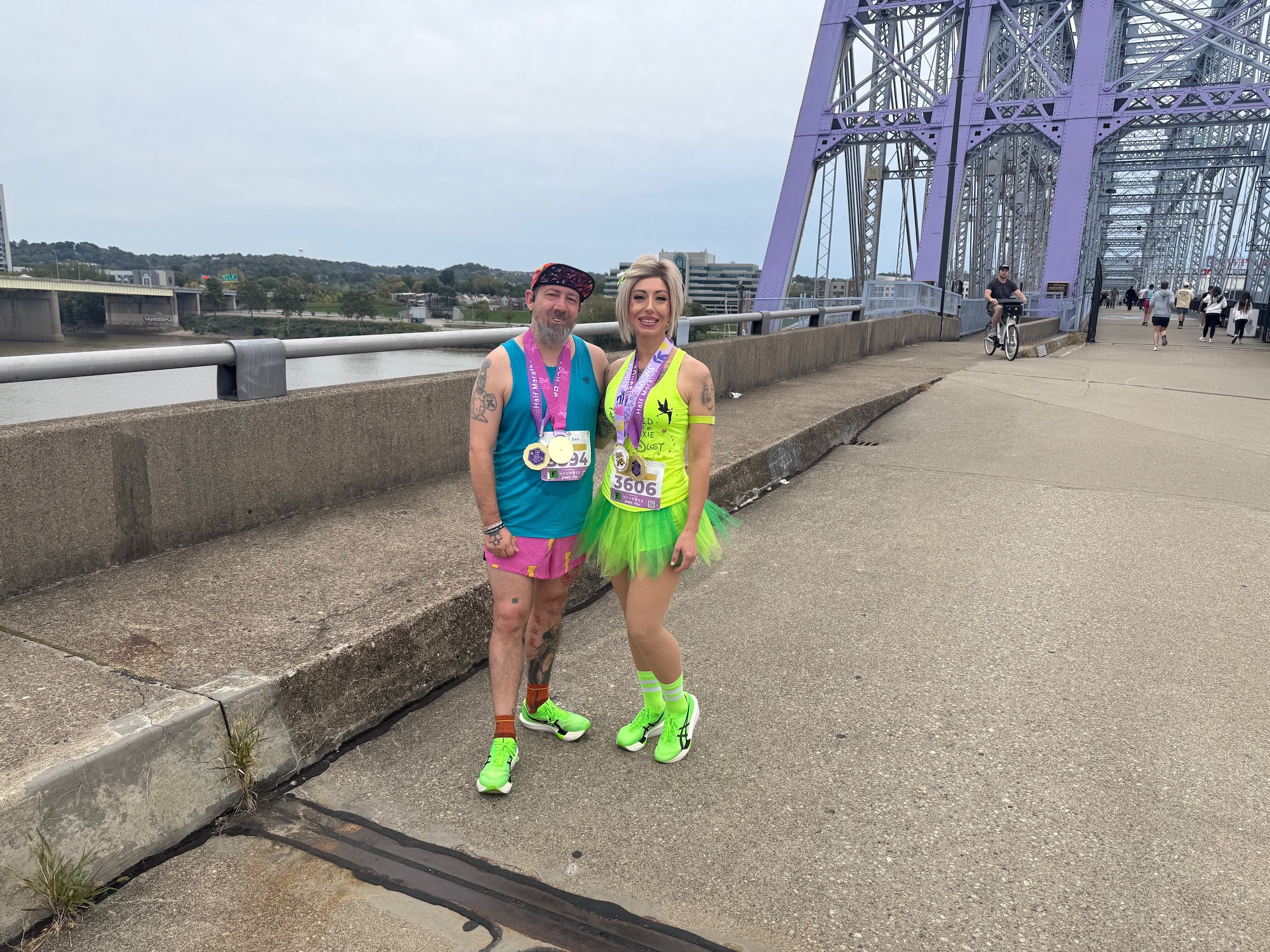
It was our first Queen Bee, and we weren't sure what parking near the start would look like. We parked in a large garage across the river in Northern Kentucky and walked over the Purple People Bridge. Other runners were already there when we pulled in. At five-something in the morning, the expensive shoes and bibs made them easy to spot. We joined them on the walk across the river.
A couple of blocks into Cincinnati, we found the crowd. Police were directing traffic around the closed streets, music was playing, and runners were everywhere. It was about 6:30.
At the Flying Pig Marathon in May, we'd learned how long it could take to find a starting corral. The groups are generally arranged by expected pace, but knowing where you belong doesn't mean you can find the entrance. There can be thousands of people between you and the sign you're looking for.
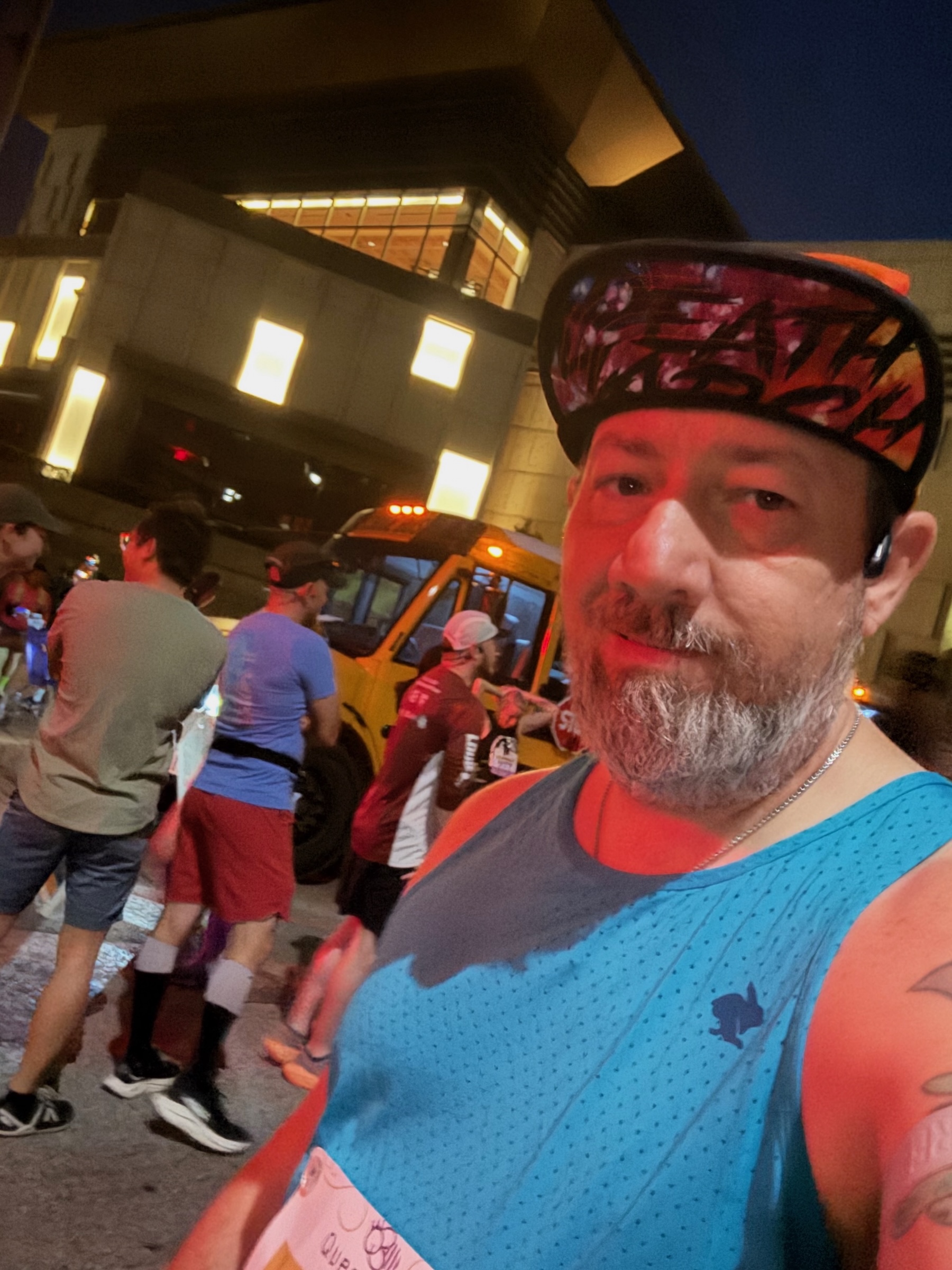
Queen Bee calls them Hives. It's a women-centered event, and men start in the final group, Hive F. Amie could have started farther forward, but she joined me in F so we could race together.
We found it without much trouble. Then my stomach started bubbling, and I remembered Amie telling me to eat carbohydrates.
The porta-potties were right beside Hive F, with the line stretching almost into our starting area. I hate public bathrooms under normal circumstances. I was very glad to see these. There was no chance I was attempting thirteen miles with my stomach doing that.
The line moved quickly, and I got back to Amie with less than thirty minutes until the start.
Large crowds make me uncomfortable. I put on music through my headphones, and Amie and I talked while the runners around us stretched and bounced around. Usually, by then, I'd be questioning my training or wondering what would go wrong. Sometimes I'd be wondering whether I should be on the starting line at all.
I waited for that to happen. I was eager to get moving, but I wasn't nervous about the race. That was unusual enough for me to notice.
When the countdown began, the Hives slowly moved forward. At the trail races I've grown to love, the start can be almost anticlimactic: people standing in the woods, somebody saying a few words, then everyone moving. Here, spectators lined both sides of the street and cheered as each group crossed the line.
I leaned toward Amie. “I feel like a gladiator being seen off to battle.”
I was mostly joking.
We didn't have an aggressive time goal. We'd covered the half-marathon distance in around 2:49 during the Flying Pig and wanted to beat that. Mostly, I wanted to see what happened if I let myself race.
I'd spent the last couple of years learning to hold back in ultras. I'd walk with purpose, keep eating and drinking, and think about what I might need six hours later. Here, I didn't have another fifty miles or a night section to prepare for.
The course was crowded from Hive F. We kept looking for openings and moving around people. I enjoyed it. I'd see somebody ahead and try to catch them, then look for the next person. Somewhere in those first miles, I realized I was smiling.
In the first mile, something fell out of my running belt. I heard it hit the ground and had to turn around, run fifteen or twenty feet back to get it, then rejoin everyone going the proper direction. It didn't bother me much. I was having fun.
We'd looked at the elevation profile and knew there was climbing early in the race. While running, we'd mostly forgotten about it. Around halfway, we started talking about the course and realized we'd already done a lot of the climbing. I hadn't paid much attention to it. I felt strong.
“I feel great,” I told Amie.
“Remember East Fork. It was great until it wasn't.”
She was right about that. I still wanted to keep running the way we were. Today, the finish was thirteen miles from the start, and I felt good.
Somewhere along the way, we caught the 2:30 pace group and passed them. Until then, I'd known we were moving well, but seeing that sign gave me a better idea of how well. I started thinking we could beat our Flying Pig split by quite a bit.
Sometimes I'd look at my watch and see that I'd drifted down toward a nine-minute mile. A few times I saw something in the 8:30s. Amie would reel me back in, which was probably sensible. What surprised me was how comfortable those paces felt at the time.
I'd spent a long time describing myself as slow. I could keep moving, but I didn't think of myself as someone who could run fast. A couple of weeks earlier, at a local 5K called Sound the Alarm, I'd begun to question that. Now I was running farther and still surprising myself.
The spectators helped. I liked hearing strangers yell my name and tell me I looked strong. I liked the cowbells and the ridiculous signs. One kid held a sign with a Super Mario mushroom on it: “PRESS HERE FOR A POWERUP.”
I reached over and pressed it as I ran past.
I swear to God it worked. For a few seconds, my legs felt lighter. I was smiling at a cardboard mushroom.
Around mile nine or ten, Amie's ankle started bothering her. After the Achilles trouble at East Fork, we were paying attention. I offered to walk. She didn't want to, so we slowed down. For a stretch, we ran closer to eleven-minute miles while seeing whether it got worse. It didn't, and we kept going.
Around then, I hit my own low. For the first time that morning, the race felt hard. I was hurting. In ultras, I'd had stretches like that and felt better later, but I was glad when I spotted someone I knew.
A volunteer along the course was an old friend I'd played in a band with. I probably hadn't seen him in ten years. I ran over and gave him what I'm sure was a completely disgusting sweaty hug, then got moving again. That helped too.
Mile thirteen was one of our fastest, around 9:30. The finish was close, and we picked up the pace. Then Amie saw what she thought was the finish line and started sprinting. I went with her.
It wasn't quite the finish.
We'd already emptied the tank and still had farther to go. We were gassed, but we kept moving. Amie crossed a couple of seconds ahead of me. My official time was 2:19:05, almost thirty minutes faster than the half-marathon distance at Flying Pig.
I've spent a lot of time over the last month thinking about what happens when races don't go the way we planned. At East Fork, we stopped after Amie's Achilles started giving her trouble. That experience became tangled up with disappointment, identity and questions we were still working through afterward.
Then Sound the Alarm happened. For 3.1 miles, I let myself race instead of holding back the way I usually did in an ultra. I discovered that maybe I was faster than I'd thought.
Queen Bee gave me something different. I spent much of the morning smiling for what felt like absolutely no reason. I smiled while weaving through runners and passing people, and when I realized we'd already climbed hills I hadn't noticed. Strangers cheered. I pressed a cardboard Super Mario mushroom and somehow received a completely legitimate powerup.
 Queen Bee 2026 Purple People Bridge
I was enjoying racing. I wasn't trying to redeem East Fork or prove I was still an ultrarunner who belonged on the starting line. I was running and having a hell of a good time doing it.
The data afterward said it was hard. My heart rate averaged 170 beats per minute. Garmin called the effort “Overreaching.” When it asked me how hard the race felt, I gave it a ten out of ten. Maximum. When it asked how I felt, I chose “Very strong.” Both answers felt right. It hurt, and I loved it.
Walking back across Cincinnati toward the car after the race, tired and still riding whatever high comes from a morning like that, I looked at Amie.
“Did I just become a road runner?”